
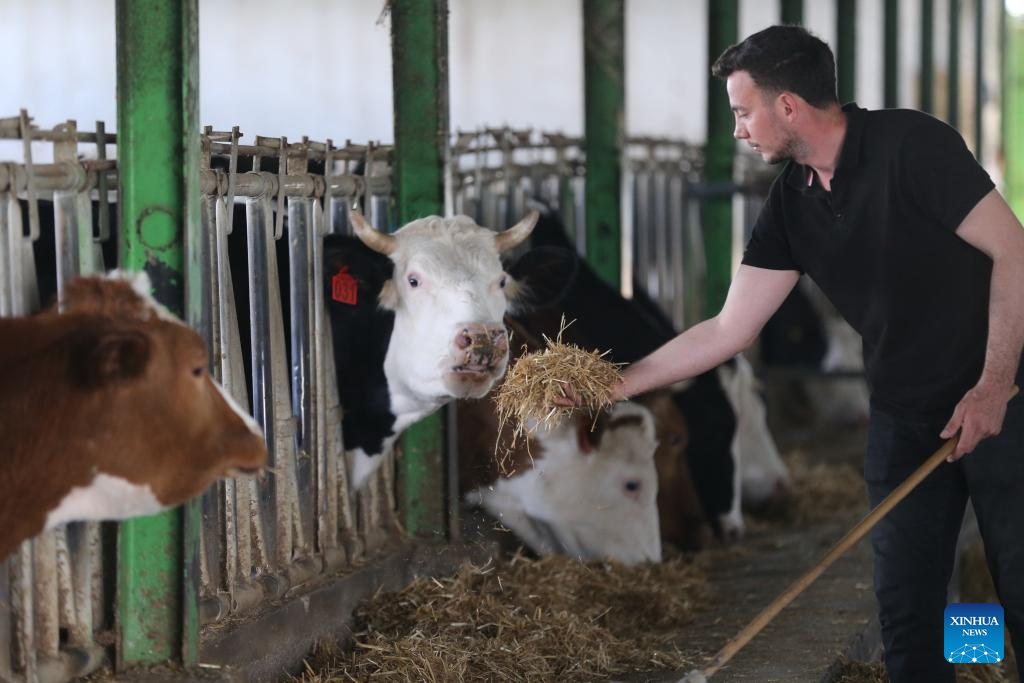
A worker feeds hay to cattle at a cattle farm in Haymana District, Ankara Province, Türkiye, on April 28, 2026. Farmers say that disruptions in global energy and fertilizer supplies, sparked by the war involving the United States, Israel, and Iran, are making their work increasingly costly, putting pressure on both production and household incomes. (Mustafa Kaya/Handout via Xinhua)
by Burak Akinci
ANKARA, April 29 (Xinhua) -- Under the wide skies of the Anatolian plateau, tractors rumble across the vast wheat fields of Haymana, near the capital, Ankara. Here, cereal fields stretch across rolling plains, while livestock farming remains a key source of livelihood for many families.
But farmers say that disruptions in global energy and fertilizer supplies, sparked by the war involving the United States, Israel, and Iran, are making their work increasingly costly, putting pressure on both production and household incomes.
Standing beside his wheat fields and dairy operation, 27-year-old farmer Turker Topal says the conflict has been felt directly in the daily costs of running a farm.
"One of the biggest impacts of the war in Türkiye has been on farmers," Topal told Xinhua.
"The most obvious example is diesel. There have been unpredictable increases in fuel prices ... Diesel is our main cost," the young farmer pointed out.
Topal represents the fourth generation of farmers in his family. On his farm, hundreds of dairy cows graze while tractors prepare nearby fields for the coming harvest. Yet the rising cost of inputs is forcing him to make difficult decisions about expansion and investment.
"When our input costs rise, it affects our milk and other production," Topal stressed, indicating that the increase in costs makes farmers like himself think twice about growing the business.
Across Türkiye, agriculture is heavily dependent on imported energy, from diesel used to power tractors to natural gas needed for fertilizer production.
As tensions in the Middle East disrupt supply routes and drive up global commodity prices, farmers are feeling the ripple effects, facing several significant fuel price hikes despite a government cap.
A key factor is the disruption of shipments through the Strait of Hormuz, one of the world's most important energy and fertilizer trade routes. The crisis has also tightened supplies of urea, a vital nitrogen fertilizer widely used in grain farming.
Erkut Kubat, deputy head of the Haymana Chamber of Agriculture, said global price fluctuations linked to oil markets are quickly transmitted to farms.
"Because of global problems and the oil-dollar relationship, farmers are inevitably affected," Kubat told Xinhua.
"Energy has a huge impact on agriculture. Petroleum products are used as fuel, in packaging and especially in transportation," he explained.
According to Kubat, the cost of key inputs have already put a strain on farmers.
"Since the beginning of the war, prices for diesel, fertilizer and other agricultural inputs have increased by more than 20 percent," he said.
Ali Ekber Yildirim, an agricultural analyst based in the western city of Izmir, said Türkiye's farmers are especially vulnerable because the country imports a large share of its agricultural inputs.
"Türkiye's agriculture is highly dependent on imported energy and fertilizer," Yildirim told Xinhua. "When energy prices rise due to geopolitical crises, the entire cost structure of farming changes."
According to Kubat, the Turkish government has introduced measures to ease the burden on farmers, including tax reductions on diesel used in agriculture.
"These steps have helped farmers to some extent. But this problem is not only about Türkiye. It is a global issue affecting farmers everywhere," he added. ■

An aerial drone photo taken on April 28, 2026 shows rapeseed fields at a farm in Haymana District, Ankara Province, Türkiye. Farmers say that disruptions in global energy and fertilizer supplies, sparked by the war involving the United States, Israel, and Iran, are making their work increasingly costly, putting pressure on both production and household incomes. (Mustafa Kaya/Handout via Xinhua)
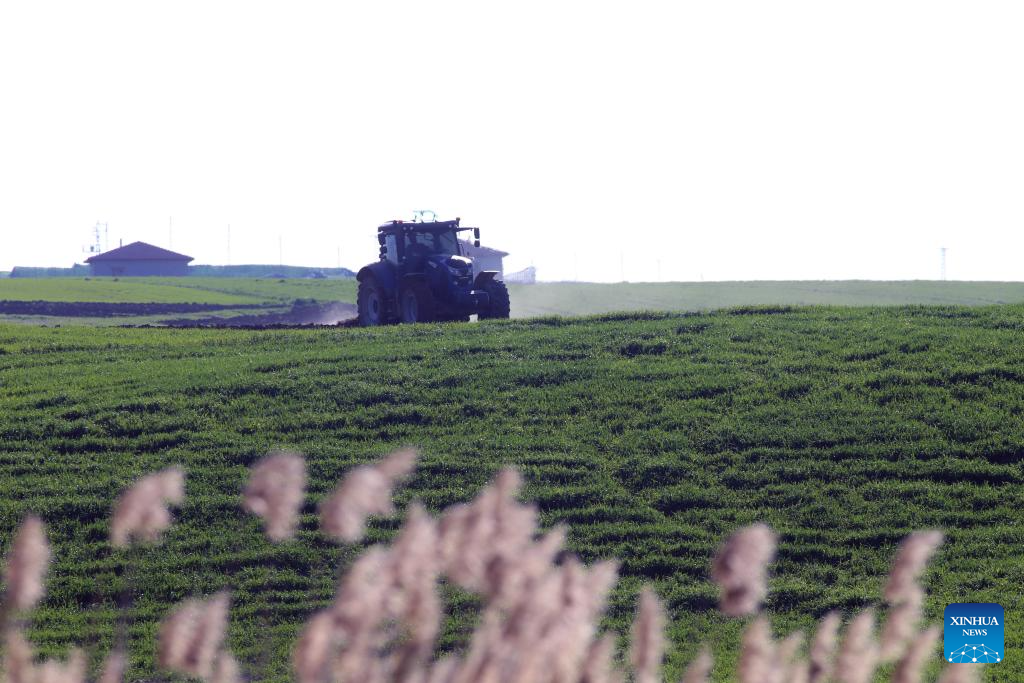
Photo taken on April 28, 2026 shows a tractor working in a field in Haymana District, Ankara Province, Türkiye. Farmers say that disruptions in global energy and fertilizer supplies, sparked by the war involving the United States, Israel, and Iran, are making their work increasingly costly, putting pressure on both production and household incomes. (Mustafa Kaya/Handout via Xinhua)


