Dominguez said that fragmented responses are no longer sufficient to resolve the crisis. "What is urgently required is diplomatic engagement, practical and neutral solutions, and coordinated international action," he noted.
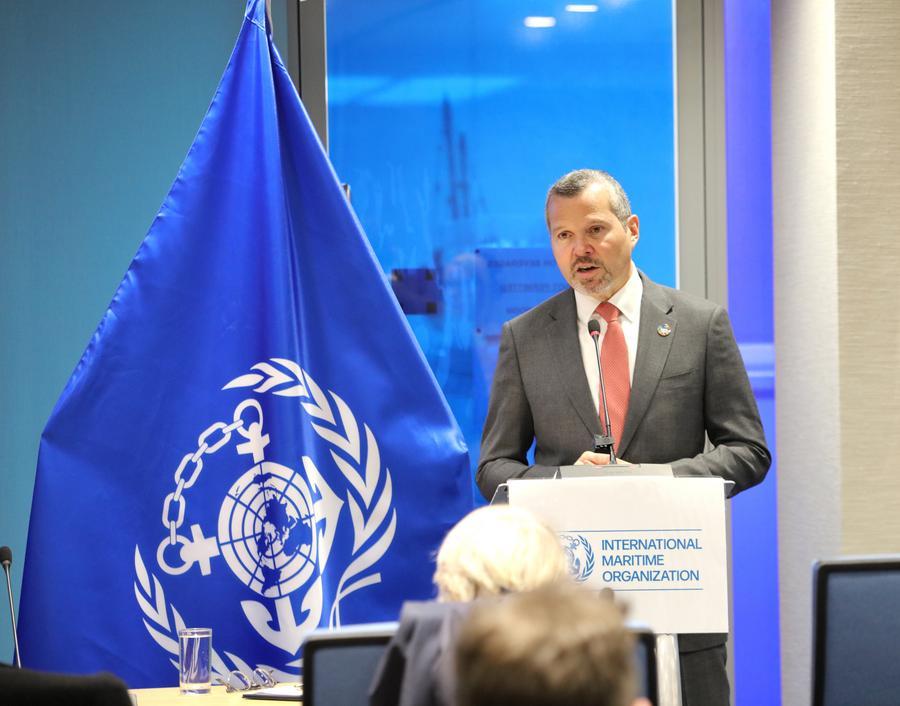
LONDON, April 2 (Xinhua) -- Secretary-General of the International Maritime Organization (IMO) Arsenio Dominguez said on Thursday that the situation in the Strait of Hormuz requires de-escalation, stressing that military approaches alone will not work and that practical maritime solutions are needed to address the crisis.
According to a press briefing released on the IMO's official website, Dominguez made the remarks while attending a virtual meeting on the situation in the Strait of Hormuz, hosted by the British Foreign, Commonwealth and Development Office, with foreign ministers from more than 40 countries participating.
During the meeting, Dominguez briefed participants on the IMO's ongoing efforts. He urged states to support diplomatic efforts to ensure the evacuation of around 20,000 seafarers currently stranded in the Persian Gulf, and to enable humanitarian corridors for urgent assistance.
Following the meeting, Dominguez said that fragmented responses are no longer sufficient to resolve the crisis. "What is urgently required is diplomatic engagement, practical and neutral solutions, and coordinated international action," he noted.
He added that the IMO is advancing a maritime evacuation framework based on cooperation among coastal states, security guarantees, and operational coordination, with the clear objective of releasing stranded vessels, enabling safe crew rotations, and preventing an environmental disaster.
Since the outbreak of the conflict on Feb. 28, when the United States and Israel launched large-scale military operations against Iran, the IMO has reported 21 attacks on commercial vessels. These incidents have resulted in the deaths of 10 seafarers, with several others seriously injured.
Following an extraordinary session of the IMO Council held on March 18-19, the IMO has taken a series of key steps, including advancing discussions with relevant states on a safe passage framework to evacuate stranded seafarers, engaging regional countries to secure supply lines and facilitate humanitarian access, and enhancing information-sharing and coordination with industry partners.
The organization has also strengthened data collection and verification on maritime incidents, while contributing to a dedicated UN task force on the Strait of Hormuz aimed at addressing humanitarian needs through coordinated technical mechanisms. ■