
by Xinhua writer Zhang Yunlong
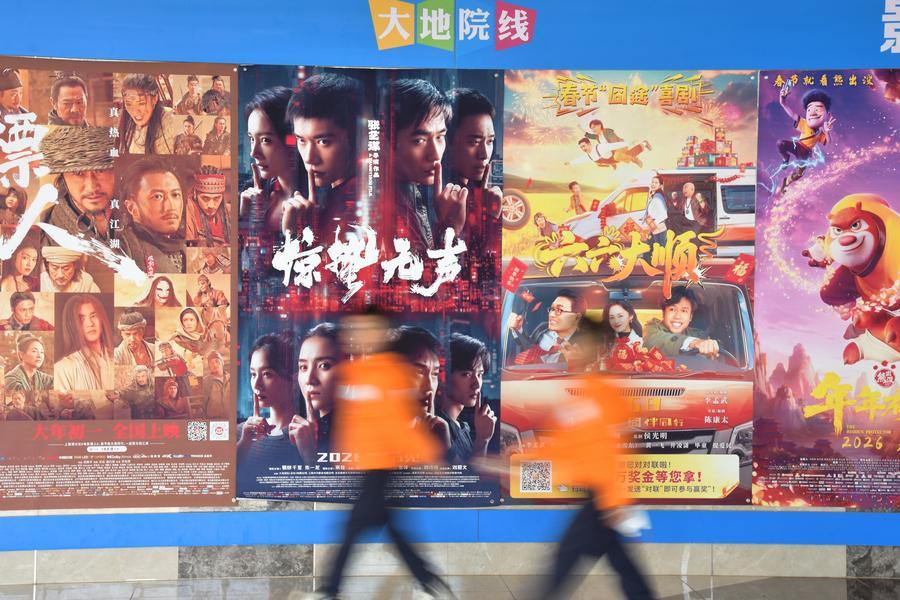
BEIJING, April 2 (Xinhua) -- Hollywood films performing strongly in North America are attracting considerably smaller audiences in China, highlighting a marked shift in viewing preferences in the world's second-largest film market.
A total of 11 foreign films opened in Chinese cinemas in March, a traditionally slow period following the Chinese New Year holiday. Together they generated 371 million yuan (about 54 million U.S. dollars), or just 17.5 percent of China's total monthly box office revenue, according to Chen Jin, an analyst at the data platform Beacon.
Only two titles -- Amazon MGM's sci-fi adventure film "Project Hail Mary" and Disney's original animation "Hoppers" -- crossed the 100 million yuan mark, data from both Beacon and ticketing platform Maoyan showed. "Project Hail Mary" took in 141 million yuan in March, while "Hoppers" earned about 120 million yuan. Several other Hollywood releases performed far more modestly. An adaptation of the classic novel "Wuthering Heights" grossed just about 34 million yuan, while Timothée Chalamet's "Marty Supreme" took in only around 3.7 million yuan.
But the two better-performing titles have still significantly underperformed their North American runs. According to Maoyan data, "Project Hail Mary" has grossed 177 million U.S. dollars in North America as of March 31, while "Hoppers" has taken in 141 million dollars -- a gap that points to broader changes in China's film market.
BETTER THAN EXPECTED, STILL A GAP
Chen described the two films' performance in China as "higher than local market expectations," noting that "Project Hail Mary" benefited from strong word-of-mouth and scored a higher box office in the second weekend than its debut weekend. On the Chinese review platform Douban, the film secured a rating of 8.5 out of 10, while "Hoppers" scored a respectable 7.6. Beacon's forecasts project a final China gross of over 200 million yuan for "Project Hail Mary" and over 160 million yuan for "Hoppers."
The cause of the disparity between the two markets remains clear. Chen attributed it in part to the films' relatively niche appeal in China. "Project Hail Mary," with its 157-minute runtime and hard science-fiction themes, may deter casual viewers, while "Hoppers" lacks the kind of established intellectual property that typically draws family audiences in small cities.
"Most imported films currently have a limited core audience in China," he said.

Lai Li, an analyst at Maoyan, offered a similar perspective. Despite the gap with North America, he noted, China is already the second-largest box office contributor globally for both films -- a result that exceeded initial market expectations.
Audience reactions, however, suggest a deeper ambivalence. "If you lower your expectations, it's actually quite enjoyable," one moviegoer wrote on social media. "But I'm really tired of Hollywood's formulaic plots and cookie-cutter characters."
STRUCTURAL SHIFT IN CHINESE CINEMA
The broader trend, analysts say, reflects a fundamental shift in the composition of China's film market. Since 2020, domestically produced films have accounted for roughly 80 percent of annual box office revenue, up from about 50 to 60 percent before 2019, according to Beacon data.
Rao Shuguang, president of the China Film Critics Association, said audience preferences have evolved significantly in recent years. "In the past, audiences were drawn to Hollywood for its industrial-scale spectacle," Rao told Xinhua. "Now they are no longer simply chasing visual effects, but are looking for emotional resonance and empathy."
He added that geopolitical tensions may also have influenced viewing choices, while underlining the importance of preserving a diverse film market. A wider range of international films, he said, can help broaden audience tastes while encouraging the domestic industry to improve quality and sustain long-term development.
NOT A SIMPLE DECLINE
For Hollywood studios, the March figures serve as a reminder that success in North America no longer guarantees comparable results in China. For China's film industry, the divergence signals a market that is becoming more self-defined and less dependent on imported blockbusters.
Yet the trend does not point to a simple decline. Imported films with strong brand recognition and broad appeal can still perform well, analysts say. Last year's "Zootopia 2," for example, grossed 4.59 billion yuan in China. ■